
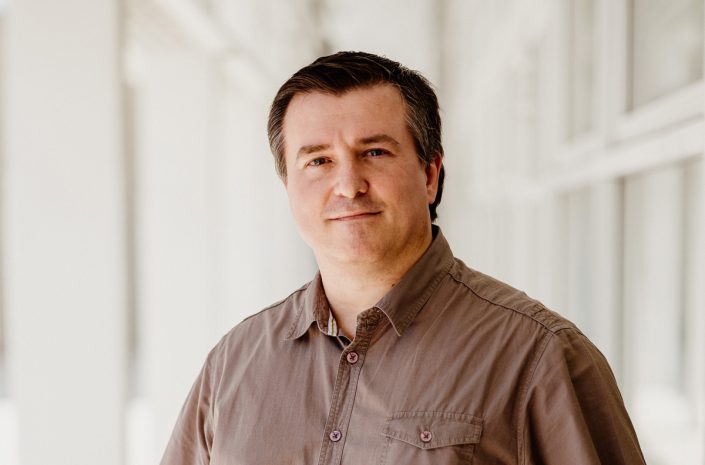
- R&D co-director and business manager. LabISEN member.
Software development
Artificial intelligence
Direction
Campus: Toulon
+ 33(0)4.83.36.19.87 / + 33(0)6.18.07.39.93
If I've seen further, it's by riding on the shoulders of giants.
Isaac Newton
Core business
A graduate engineer from ISEN Yncréa Méditerranée, Ghislain Oudinet defended his thesis in the fields of image processing and computer science. He teaches computer science, and more specifically programming languages and optimization, to both new engineering students and those at the end of their studies, whom he accompanies on industrial or research projects. He teaches them "how to use IT tools to solve concrete problems". Ghislain also carries out research and development work for industry, notably for projects linked to the Internet of Things and artificial intelligence.
Prospective
The idea is that the computer tool adapts to the human and not the other way around, as is still too often the case. In response to a possible physical barrier that would prevent an increase in computing power, the teams are using an ever-increasing number of software techniques and are managing to solve increasingly difficult problems. It is now a question of improving the quality of the programs, but also their robustness, while taking care to maintain their simplicity, i.e. a level of complexity that is just sufficient. Ghislain takes these parameters into account in his work on genetic algorithms and reinforcement learning. These technologies require the implementation of less computation than those required to process neural network or deep learning environments. It aims for the best final result by optimizing the use of resources to achieve it. Faced with the unexpected," says Ghislain, "it is still the human being who is the most efficient.
360°
The ecosystem in which the teams operate, both locally and internationally, is constantly evolving. Today, the available chips are powerful while being generic. It is possible to specialize them, at a lower cost, through software that is easy to correct and update. One of the strengths of Yncréa Méditerranée is to master the microelectronics of hardware systems but also the software that allows the implementation of all current technologies. This multicompetence allows the school to respond positively to requests for complex services.
About me
After graduating in 1998 (ISEM, former name of ISEN Yncréa Méditerranée), I did a master's degree in Image and Materials at CPE Lyon/ENTPE Vaulx-en-Velin, and then a thesis on the 3D reconstruction of the microstructure of sintered materials by image analysis. This computer science oriented thesis allowed me to explore notions of measurement physics as well as genetic algorithms to propose a solution to a problem where we try to identify a cause by analyzing its effects, without having access to the measurement of all the model parameters. Then I was able to join the ISEN Yncréa Méditerranée team as a teacher-researcher in computer science.
Areas of expertise
My main areas of interest are programming languages, optimization and parallelization of code to achieve the highest computational performance, as well as biologically inspired techniques (genetic algorithms, reinforcement learning and neural networks).
Research and development activities
My current activities are mainly focused on the creation of software solutions, and more occasionally and particularly on techniques to develop and implement algorithms, which can use artificial intelligence as well as massively parallel computing, but always with the objective of low resource and energy consumption. I am particularly interested in ensuring that technologies serve the need, and not the other way around.
Teaching activities
Languages: C, C++, Java, Python, Objective-C, Swift
Techniques: parallel programming, object-oriented programming, real-time programming