
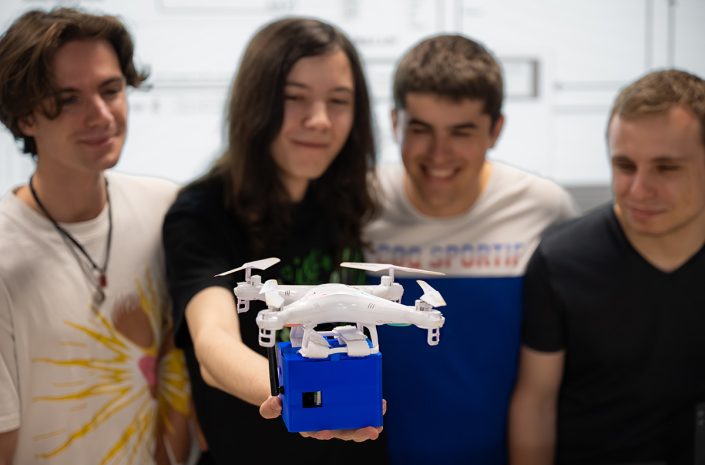
Creating the robots and drones of tomorrow
Robotics and embedded systems are two fields in constant development, and the basis of numerous applications: drones, mobile land and submarine
vehicles, parallel robots, biomechanics, humanoids, robots, intelligent sensor networks.
This double degree option enables students to acquire skills in the analysis and development of control algorithms adapted to the field of robotics (automatic control, artificial intelligence, on-board algorithms), as well as know-how in the design of land or underwater UAVs, including mastery of a wide range of scientific and technical skills: mathematics, computer science, mechanics, electronics, pneumatics, hydraulics.
Admission
Bac+2
Campus
Toulon & Marseille
Program Length
3 years (6 semesters)
Targeted degree
Ingénieur
→ RNCP42791
Mobile robotics option program
The engineering cycle consists of 3 years. The 1st year is a turning point in terms of skills acquisition. Here, students prepare for the common core of the engineering cycle, and at the end of the year choose their option.
| Year 4 (ECTS) | Year 5 (ECTS) | |
|---|---|---|
| Artificial intelligence | 5 | - |
| Microcontrollers and interfaces | 5 | - |
| System development | 5 | - |
| IoT systems engineering | 5 | - |
| Technical Project | 10 | - |
| SHES | 6 | - |
| English | 4 | - |
| Physics and Safety | 5 | - |
| Robotics | 5 | - |
| Design analog | 5 | - |
| Engineering application internship | 5 | - |
| Microelectronics and manufacturing | - | - |
| Double-diploma University of Toulon | - | 60 |
98%
insertion rate 5 months after graduation
Pro contract
possible in 5th year (1 year)
The European Credit Transfer and Accumulation System ( ECTS ) is a points system developed by the European Union as part of the Bologna Process and theEuropean Higher Education Area(EHEA). Credits are divided into teaching units (UE).
It aims to make it easier to read and compare study programmes within a country and between different European countries. The ECTS system applies mainly to university education. It is applied in France and has replaced the system of credits (UV) previously used.
Why choose this course at ISEN Méditerranée?
This course leads to a double diploma with the University of Toulon: a national master's degree in "Complex Systems Engineering", with a specialization in "Robotics and Connected Objects".
This program enables students to acquire expertise in robotics that is recognized both in France and internationally, thanks to this academic partnership and the links forged with industrial players.

Our students have access to modern laboratories equipped with the latest technologies in robotics, electronics and programming.
They work on practical projects, encouraging experimentation, creativity and the application of skills.
Certification and recognition
This course has been awarded the " Formation d'ingénieur diplômé par l'État " label by the Commission des titres d'ingénieur (Cti), which assesses the quality of engineering courses at French engineering schools. This label guarantees that the training offered is recognized by the French government and meets the highest standards of quality and academic rigor.
Admission
This program is available after a bac+3, at ISEN, or in parallel admission to candidates from bac+3, university, BUT (GEII, Mesures Physiques réseaux et Télécoms, Informatique), BTS (Systèmes numériques, électrotechnique) or another engineering school.
ISEN success is
98%
student employed
5 months after graduation.

10000
ISEN Engineers
40 700€
of gross annual salary at hiring

100%
of graduates have international experience

Who should attend?
This course is designed for students with a passion for technological innovation, robotics and engineering sciences. If you like understanding, designing and improving technological systems, this is the course for you. You'll develop solid skills in electronics, embedded computing and artificial intelligence, which are essential in the fields of robotics and automation.
High school students with a scientific background who have gone on to study a BUT or BTS will find it a natural extension of their learning. The course will enable them to deepen their knowledge while applying it to concrete, innovative projects.
International mobility
This cycle offers a semester of international study in 4th year, to gain experience abroad and gain exposure to other cultures and ways of working.
What's next?
A booming market
The field of mobile robotics is growing exponentially, driven by the rise of automation, artificial intelligence and autonomous systems. Engineers specializing in this sector can work in a variety of environments, including :
- Aerospace and defense: design of drones, exploration and maintenance robots for critical infrastructures.
- Health and assistance: development of robots to help the elderly, for rehabilitation or surgical assistance.
- Industry and logistics: design of autonomous robots for warehouse logistics, production lines and materials handling.
- Automotive: development of autonomous vehicles, surveillance robots and driver assistance systems.
- Agriculture: crop automation with monitoring, maintenance and harvesting robots.
- Energy: deployment of robots for the inspection, maintenance and optimization of energy infrastructures, such as power grids, pipelines and wind or solar power plants.
Remuneration to match skills
Salaries in mobile robotics are high, driven by demand for high-performance autonomous systems. At the start of their career, engineers earn between €42,000 and €48,000 gross per year in France.
With experience, salaries often reach €55,000 to €75,000, particularly in the defense, automotive and logistics sectors. Internationally, they start at around €60,000.
Confirmed profiles, such as project managers or technical experts, can exceed €90,000.
(Source Michael Page - 2025)
Career opportunities after training in mobile robotics
An engineering degree in mobile robotics opens up a wide range of opportunities in a variety of fast-growing sectors. Mobile robotics is at the heart of innovation in fields ranging from automobiles to autonomous drones. Here are just a few possible career opportunities:
Mobile robot design engineer
Description: design, development and optimization of autonomous robots for various environments.
Key skills: robot modeling and control, embedded programming (C++, ROS), sensor integration (LiDAR, cameras, IMU (Inertial Measurement Unit)).
Applications: logistics, defense (naval and airborne UAVs), space exploration.
Artificial intelligence engineer applied to robotics
- Description: development of machine learning and computer vision algorithms for autonomous navigation.
- Key skills: machine learning, image processing, trajectory planning.
- Applications: autonomous vehicles, industrial robotics, drones.
Embedded systems engineer
Description: design and integration of mechanical and electronic systems for mobile robots.
Key skills: CAD, on-board electronics, engine control.
Applications: medical robotics, industrial automation, agro-technology.
Collaborative Robotics Engineer
- Description: development of robots capable of interacting with humans in complete safety.
- Key skills: human-machine interaction, proximity sensors, decision-making algorithms.
- Applications: personal assistance, industry 4.0, exoskeletons.
Perception and Autonomous Navigation Engineer
Description: design of perception and localization systems for mobile robot navigation.
Key skills: SLAM (Simultaneous Localization and Mapping), sensor fusion, real-time data processing.
Applications: drones, autonomous vehicles, surveillance robots.
Practical information
Duration and pace of training
The course lasts 3 years, with the option of doing the final year on a sandwich course with a company.
Location
This course is given both on our main campus in Toulon and on the Université de Toulon campus in La Garde (a neighboring town).
A semester abroad is available in the 2nd year of the program.
Cost and possible financing
You can find all our tuition fees on this page.
It is possible to complete the final year of training on a sandwich course. In this case, the tuition fees are paid by the employer, and the student also receives a salary.
It also accelerates the professionalization of our students. Being trained both at school and in the field makes it even easier to get a permanent job at the end of the course.
You can apply for a scholarship every year. The various scholarships offered by ISEN can cover up to 100% of tuition fees.
Campus life
Campus life at ISEN Méditerranée Toulon is both stimulating and enjoyable. Located near the port and beaches, the campus offers a unique living environment. Students benefit from modern infrastructures, coworking spaces and innovative laboratories. Numerous events, such as the Semaine de la Vie Étudiante (Student Life Week), promote integration and cohesion. All in all, an environment conducive to personal and academic fulfillment.
Part of the curriculum takes place near Toulon, on the La Garde university campus.